Risk landscapes are not static. They evolve as economic conditions, technologies and geopolitical dynamics change. Organisations that rely on outdated risk views are often unprepared for new forms of disruption.
A clear distinction must be made between emerging risks and persistent risks. Emerging risks are new or rapidly evolving threats whose impact and likelihood are still uncertain. Persistent risks are known risks that continue to intensify or interact in new ways.
By 2026, risks are expected to be faster-moving, more interconnected and harder to isolate. Traditional risk registers and silo-based assessments struggle to capture these dynamics.
This article outlines the key drivers shaping the 2026 risk landscape, identifies major emerging and present risks, and highlights implications for risk management and governance.
Understanding the Risk Landscape Concept
A risk landscape provides a high-level view of the most relevant risks facing an organisation at a given point in time. Unlike a risk register, it focuses on trends, interdependencies and forward-looking exposure.
Modern risk landscapes recognise that risks rarely materialise independently. Financial, operational, technological and geopolitical risks often reinforce each other, increasing overall impact.
Horizon scanning and scenario analysis are essential tools for understanding the risk landscape. They help organisations anticipate change rather than react to isolated events.
Static assessments remain useful but insufficient. In a volatile environment, risk landscapes must be reviewed and updated regularly to remain relevant.
Key Drivers Shaping the 2026 Risk Landscape
Macroeconomic and Financial Drivers
Macroeconomic uncertainty remains a dominant risk driver. Interest rate volatility, high debt levels and uneven growth continue to challenge financial stability.
Refinancing risk is increasing as debt matures in a higher-rate environment. This affects corporates, households and sovereigns, with potential spillovers to the financial system.
Market liquidity remains fragile. Periods of stress may expose hidden leverage, valuation mismatches and concentration risks.
Geopolitical and Geoeconomic Drivers
Geopolitical fragmentation is reshaping global trade and investment. Strategic competition, regional conflicts and sanctions are increasing uncertainty and operational complexity.
Economic nationalism and trade restrictions are disrupting established supply chains. Organisations face higher costs, reduced diversification and regulatory divergence.
Energy security remains a structural concern. Price volatility and supply disruptions continue to affect inflation, production and strategic planning.
Technological Drivers
Digitalisation is accelerating across sectors. While enabling efficiency and innovation, it also increases dependency on complex and often opaque technology ecosystems.
Artificial intelligence and automation are transforming decision-making processes. Governance, accountability and control frameworks are struggling to keep pace.
Technology concentration and third-party reliance increase systemic risk. Failures at key providers can have widespread operational impact.
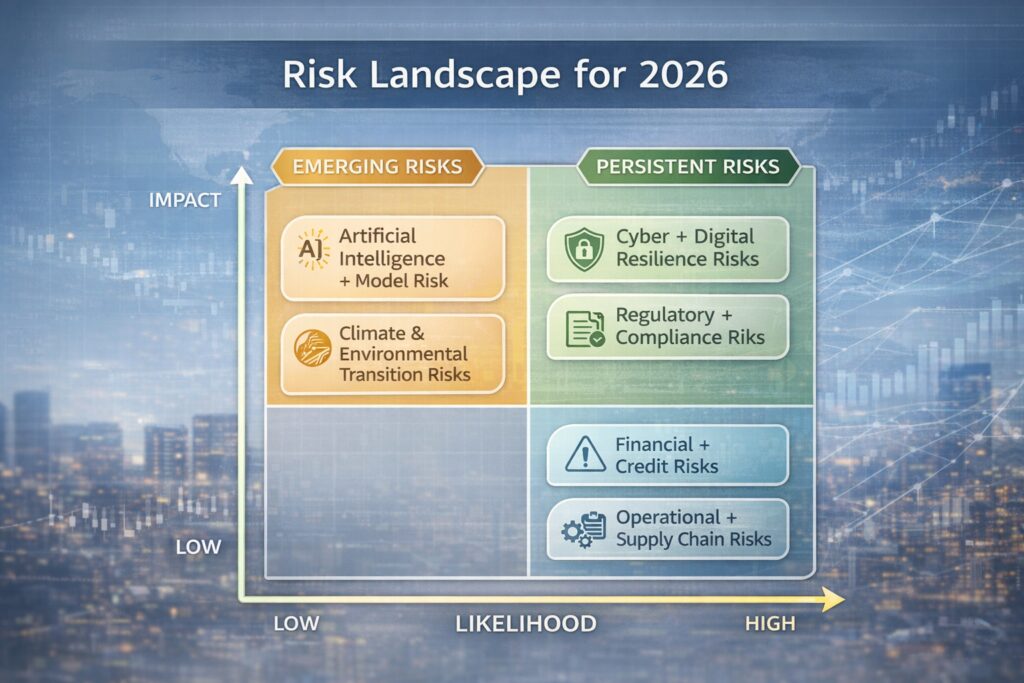
Emerging Risks for 2026
Artificial Intelligence and Model Risk
AI adoption is expanding rapidly, often faster than governance frameworks. Model opacity, data bias and explainability issues create new forms of risk.
Regulatory expectations around AI are evolving. Uncertainty around compliance, accountability and liability increases legal and reputational exposure.
Over-reliance on automated decision-making may weaken human oversight, particularly under stress conditions.
Cyber and Digital Resilience Risks
Cyber risk continues to evolve in scale and sophistication. Ransomware, supply-chain attacks and systemic outages pose growing threats.
Digital incidents increasingly affect critical services, financial stability and public trust. Recovery times and costs are rising.
Cyber resilience is becoming as important as cyber prevention. Business continuity and response capabilities are key differentiators.
Climate and Environmental Transition Risks
Climate risk is shifting from a long-term concern to a near-term financial risk. Physical events and transition pressures are materialising faster than expected.
Regulatory, legal and investor scrutiny is increasing. Organisations face higher compliance costs and litigation exposure.
Insurance availability and affordability are becoming constraints, particularly in high-risk regions and sectors.
Social and Workforce Risks
Labour markets remain tight in key skill areas. Talent concentration increases dependency on critical individuals and teams.
Remote and hybrid working models introduce control, culture and operational risks that are not yet fully embedded in risk frameworks.
Demographic trends place pressure on productivity, public finances and workforce planning.
Persistent and Heightened Risks
Financial and Credit Risks
Credit risk remains elevated across sectors. Defaults, restructurings and counterparty stress are likely to increase in a weaker growth environment.
Risk concentration is a growing concern. Correlated exposures reduce diversification benefits during downturns.
Liquidity and funding risks persist, particularly for highly leveraged or market-dependent entities.
Operational and Supply Chain Risks
Operational resilience remains uneven. Dependencies on critical suppliers and single points of failure continue to expose organisations to disruption.
Reshoring and nearshoring reduce some risks but introduce others, including cost pressures and execution challenges.
Business continuity frameworks often lag behind the complexity of modern operations.
Regulatory and Compliance Risks
Regulatory requirements are expanding in scope and complexity. Divergence across jurisdictions increases compliance risk and operational burden.
Supervisory expectations around governance, data quality and risk management are rising.
Failure to meet regulatory standards increasingly results in reputational damage, not just financial penalties.
Interconnected and Systemic Risk Themes
Interconnection is a defining feature of the 2026 risk landscape. Shocks propagate quickly across sectors and geographies.
Correlation increases under stress, undermining traditional diversification assumptions. Risks that appear independent in normal conditions may materialise simultaneously.
Systemic risk is no longer confined to the financial sector. Technology, climate and geopolitical risks can trigger system-wide disruption.
Effective aggregation and scenario analysis are essential to understand these dynamics.
Implications for Risk Management and Governance
Silo-based risk management is increasingly ineffective. Fragmented approaches fail to capture cross-risk dependencies and escalation pathways.
Enterprise risk management plays a central role in integrating risk perspectives and supporting strategic decision-making.
Boards require clearer, more forward-looking risk information. Risk appetite and tolerance frameworks must be stress-tested against emerging scenarios.
Governance structures must balance oversight with agility. Excessive complexity can slow responses in fast-moving situations.
Preparing for the 2026 Risk Landscape
Scenario-based risk assessment is critical. Organisations should explore severe but plausible scenarios rather than rely on point forecasts.
Stress testing and reverse stress testing help identify vulnerabilities that may not be visible in baseline conditions.
Risk culture and escalation mechanisms must support early identification and decisive action.
Data and analytics can enhance insight, but only if supported by sound governance and judgement.
Call to Action
The 2026 risk landscape is defined by uncertainty, interconnection and speed. Emerging risks are becoming material faster, while persistent risks continue to intensify.
Effective risk management is less about prediction and more about preparedness. Organisations that understand their risk landscape are better positioned to respond and adapt.
To explore practical tools, insights and frameworks that support forward-looking risk analysis and enterprise risk management, visit our website and strengthen your approach to managing future risk.