Risk-taking appetite is inherent to business. What differentiates resilient organisations from fragile ones is not the absence of risk, but clarity on how much risk they can accept and under what conditions.
In recent years, boards and regulators have placed increasing emphasis on risk appetite frameworks. Strategic failures, financial crises and operational disruptions have repeatedly shown that unmanaged risk-taking often stems from unclear boundaries rather than poor intent.
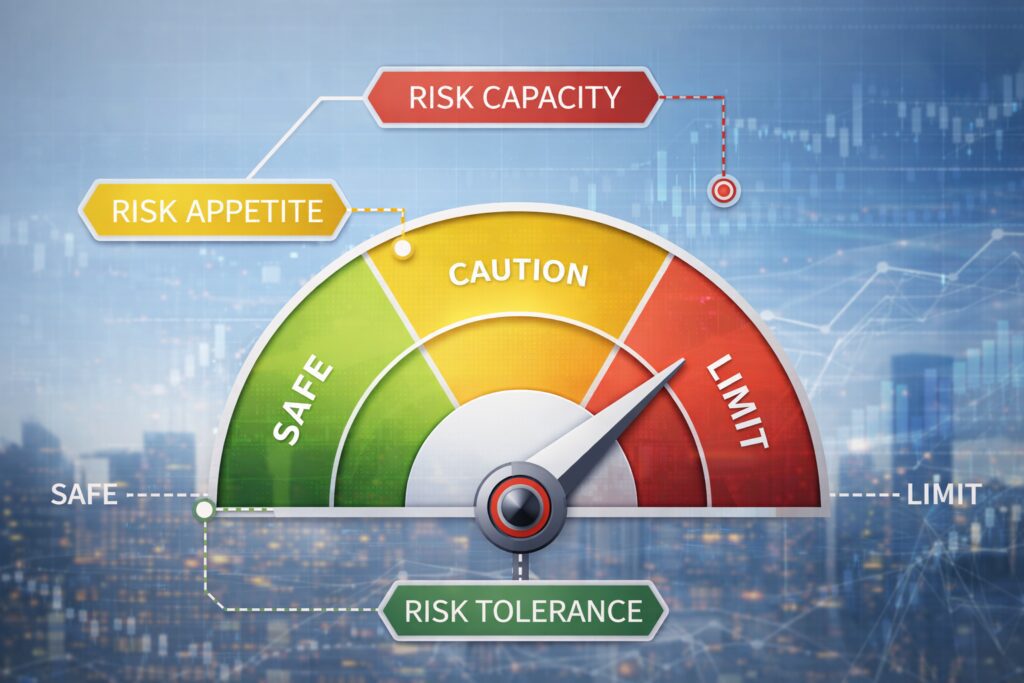
Risk appetite, risk tolerance and risk capacity are closely related but distinct concepts. They are frequently used interchangeably, which leads to weak governance and inconsistent decision-making.
This article clarifies these concepts, explains how they fit together, and outlines their role in effective enterprise risk management.
Why Risk Appetite Matters
Risk appetite defines how an organisation chooses to take risk in pursuit of its objectives. It provides a reference point for decision-making across strategy, operations and financial management.
Without a clearly articulated risk appetite, decisions are taken inconsistently. Business units may pursue growth that exceeds the organisation’s ability to absorb losses, while control functions struggle to challenge risk-taking in a structured way.
A well-defined risk appetite supports alignment. It links strategic ambitions to acceptable levels of risk and ensures that risk-taking remains intentional rather than accidental.
From a governance perspective, risk appetite strengthens accountability. It enables boards and senior management to assess whether actual risk exposure remains consistent with stated intentions.
Risk Capacity
Definition
Risk capacity represents the maximum level of risk an organisation can absorb without threatening its viability. It is a hard limit rather than a strategic choice.
Capacity reflects the organisation’s ability to withstand severe but plausible losses. Breaching risk capacity may result in insolvency, regulatory intervention or irreversible reputational damage.
Unlike risk appetite, risk capacity is not subjective. It is determined by financial strength, operational resilience and external constraints.
Determinants of Risk Capacity
Financial resources are a primary driver of risk capacity. Capital adequacy, liquidity buffers and earnings stability define how much loss the organisation can sustain.
Operational factors also matter. Business continuity capabilities, reliance on critical suppliers and system resilience influence the organisation’s ability to operate under stress.
Legal, regulatory and contractual constraints further limit risk capacity. Regulatory capital requirements, solvency rules and covenants impose non-negotiable boundaries on risk-taking.
Role in Risk Management
Risk capacity sets the outer boundary of acceptable risk. It defines what must never be breached, regardless of strategic ambition.
Effective risk management ensures that risk appetite is set well within risk capacity. This buffer protects the organisation against model uncertainty, correlation breakdowns and extreme events.
Ignoring risk capacity undermines governance. When strategic decisions approach or exceed capacity limits, the organisation becomes vulnerable to shocks and loss of control.
Risk Appetite
Definition
Risk appetite defines the amount and type of risk an organisation is willing to accept in pursuit of its objectives. It reflects strategic intent rather than absolute limits.
Unlike risk capacity, risk appetite is a choice. It expresses how management and the board balance growth, return and resilience.
A clear risk appetite provides direction. It guides decision-making across business lines and ensures consistency in how risk is taken and managed.
Qualitative and Quantitative Risk Appetite
Risk appetite is expressed through both qualitative and quantitative elements. Qualitative statements describe attitudes to risk, such as risk aversion in specific activities or markets.
Quantitative measures translate intent into measurable boundaries. These may include capital ratios, earnings volatility limits or exposure thresholds.
Effective frameworks align both dimensions. Qualitative guidance without metrics lacks enforceability, while metrics without context encourage mechanical compliance.
Risk Appetite and Strategy
Risk appetite must be aligned with strategy. Ambitious growth targets require acceptance of higher risk, while defensive strategies imply tighter constraints.
Boards play a central role in approving and reviewing risk appetite. This ensures that strategic decisions remain consistent with the organisation’s risk-bearing capacity.
When strategy changes, risk appetite must be reassessed. Misalignment between the two is a common source of risk governance failures.
Risk Tolerance
Definition
Risk tolerance defines the acceptable level of variation around risk appetite. It translates strategic intent into operational boundaries.
Tolerance sets the range within which risk exposure may fluctuate without triggering management action. It acts as an early warning mechanism rather than a hard limit.
While appetite is set at enterprise level, tolerances are often defined at business unit, portfolio or process level.
Risk Tolerance in Practice
Risk tolerance is implemented through limits, triggers and thresholds. These mechanisms ensure timely escalation when risk exposure approaches appetite boundaries.
Effective tolerances are specific and measurable. Vague thresholds reduce their usefulness and delay corrective action.
Tolerance breaches do not imply failure. They signal the need for review, adjustment or mitigation before capacity is threatened.
Relationship with Appetite and Capacity
Risk tolerance operationalises risk appetite. It ensures that day-to-day decisions remain consistent with enterprise-level intent.
Tolerance levels must always sit within risk capacity. Operating too close to capacity leaves little margin for uncertainty or stress.
Together, capacity, appetite and tolerance form a coherent control structure. Weakness in any one element undermines the effectiveness of the others.
How Risk Capacity, Appetite and Tolerance Fit Together
Risk capacity defines the maximum loss the organisation can absorb. It represents the outer boundary of risk-taking.
Risk appetite sits within this boundary. It reflects how much risk the organisation chooses to take in pursuit of its objectives.
Risk tolerance defines the acceptable range of fluctuation around appetite. It ensures that deviations are detected and addressed early.
This hierarchy supports disciplined risk-taking. It enables growth while preserving resilience and control.
Embedding Risk Appetite in the Organisation
Risk appetite must be embedded into decision-making processes. Board statements alone are insufficient.
Policies, limits and approval frameworks should reflect appetite and tolerance levels. This ensures consistent application across the organisation.
Risk appetite should also influence performance management. Incentives that reward excessive risk-taking undermine governance and control.
Clear communication is essential. Employees must understand not only the limits, but the reasoning behind them.
Common Challenges and Pitfalls
Many organisations adopt generic risk appetite statements. These provide limited guidance and little practical value.
Over-reliance on quantitative metrics can be misleading. Not all risks are easily measurable, particularly emerging and non-financial risks.
Another common issue is disconnect. Risk appetite is defined centrally but ignored in business decisions, leading to inconsistent risk-taking.
Regular review is often overlooked. Risk appetite frameworks must evolve with strategy, market conditions and external shocks.
The Future of Risk Appetite Frameworks
Risk appetite frameworks are becoming more dynamic. Digital tools and risk analytics are improving monitoring and escalation. You can refer to our dynamic risk appetite framework template.
Scenario-based approaches are gaining importance. Stress testing helps assess whether appetite remains appropriate under adverse conditions.
Emerging risks such as cyber threats, climate change and geopolitical instability require broader definitions of risk appetite.
As a result, risk appetite is shifting from static documentation to an active management tool.
Call to Action
Risk appetite, risk tolerance and risk capacity are foundational to effective risk management. Together, they define how much risk an organisation can take, chooses to take and is prepared to manage.
Clear definitions, strong governance and practical implementation are essential. Without them, risk-taking becomes inconsistent and reactive.
Organisations seeking to strengthen their risk frameworks should adopt an integrated and disciplined approach. Explore our website for tools, insights and practical guidance to support robust risk appetite and enterprise risk management.