Why Structured Analysis Matters
Organisations operate in increasingly complex environments where decisions must be made quickly and often under uncertainty. While data is more available than ever, the ability to use it effectively remains a challenge. Without a clear structure, analysis can become inconsistent, reactive or influenced by bias and incomplete thinking.
In many cases, poor decisions are not caused by a lack of information, but by weak problem definition, inadequate planning or flawed interpretation of results. This is particularly visible in risk management and governance, where decisions must be justified, documented and defensible.
Structured analytical frameworks help address these issues by creating consistency, improving traceability and supporting evidence-based decision-making. Among these, the PPDAC cycle stands out as a practical and widely applicable approach.
What Is the PPDAC Cycle?
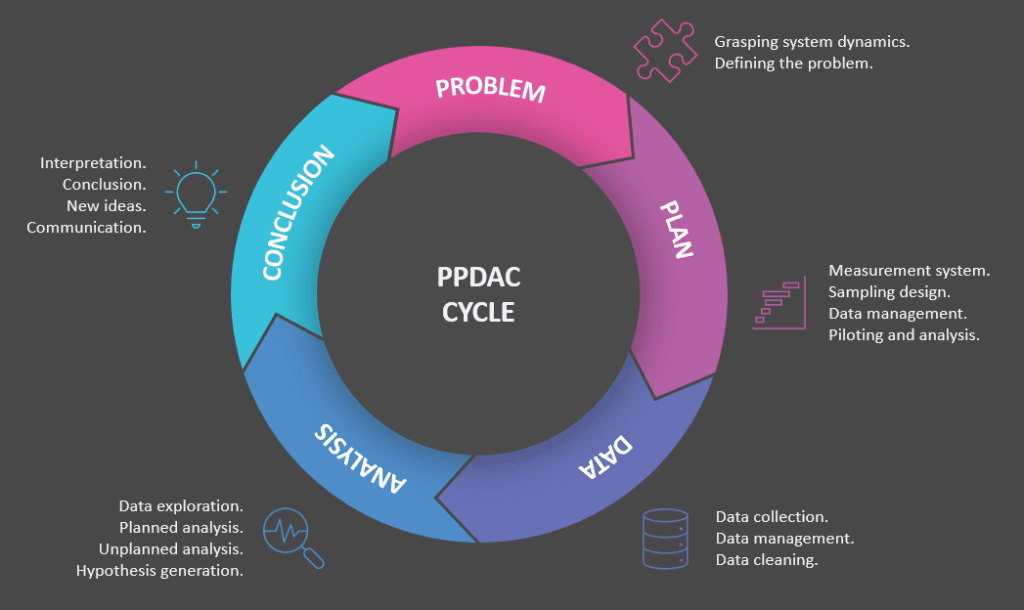
The PPDAC cycle is a structured framework used in statistical inquiry and analytical problem-solving. It consists of five key stages: Problem, Plan, Data, Analysis and Conclusions.
Rather than focusing purely on data analysis, the framework captures the full lifecycle of decision-making. It begins with defining the right question and ends with drawing conclusions that inform action. Each stage is connected, ensuring that decisions are grounded in a logical and transparent process.
This structured approach is particularly valuable in environments where accountability, auditability and clarity are essential, such as finance, public policy and risk management.
Defining the Right Question
The success of any analysis depends heavily on how well the problem is defined. A poorly framed question can lead to irrelevant data, wasted effort and misleading conclusions.
Organisations often fall into the trap of addressing symptoms rather than root causes. For example, a decline in performance might trigger analysis of outputs, when the real issue lies in process inefficiencies or external factors. A clear and precise problem statement helps avoid this by focusing attention on what truly matters.
Defining objectives is equally important. Decision-makers need to understand what is being analysed, why it matters and what success looks like. At this stage, it is also essential to identify key uncertainties and risks that may influence the outcome.
Scope must be carefully managed. An overly broad analysis can become unmanageable and dilute insights, while an overly narrow focus may miss critical variables. Striking the right balance ensures that the analysis remains both practical and meaningful.
Designing the Right Approach
Once the problem is clearly defined, the next step is to design an appropriate analytical approach. This involves selecting methodologies, defining metrics and determining how data will be collected and assessed.
Different types of problems require different approaches. Quantitative methods may be suitable for measuring trends or performance, while qualitative approaches can provide insight into behaviours, motivations or operational realities. In many cases, a combination of both delivers the strongest results.
Planning also requires a realistic assessment of constraints. Time, cost, data availability and organisational capacity all influence what can be achieved. Ignoring these factors can result in overly ambitious or impractical analysis.
Governance plays an important role at this stage. Clear roles and responsibilities, along with validation and review processes, help ensure that the analysis is conducted consistently and that any issues are identified early.
Collecting Relevant Information
Data is the foundation of the PPDAC cycle, but its value depends on both quality and relevance. Collecting large volumes of data does not automatically improve analysis; in fact, it can introduce noise and make interpretation more difficult.
Relevant data may come from a variety of sources, including internal systems, operational reports, surveys or external datasets. Both structured and unstructured data can provide valuable insights when used appropriately.
Data quality remains one of the most significant challenges. Incomplete, outdated or inconsistent data can introduce significant risk into the process. Bias in data collection or reporting can further distort findings and lead to flawed conclusions.
A balanced approach is essential. Quantitative data offers measurable insights and comparability, while qualitative data provides context and helps explain underlying drivers. Together, they create a more complete and reliable picture.
Turning Data into Insight
The analysis stage is where data is transformed into insight. Depending on the problem, this may involve statistical analysis, trend identification, modelling or scenario testing. The objective is to identify patterns, relationships and potential drivers that inform decision-making.
However, this stage also introduces new risks. One of the most common is the misinterpretation of relationships within the data. Correlation does not imply causation, yet this distinction is often overlooked.
Another challenge is false precision. Complex models and detailed calculations can create a sense of certainty that is not justified by the underlying data. Recognising uncertainty and clearly communicating it is essential for maintaining analytical integrity.
Equally important is the ability to communicate results effectively. Technical findings must be translated into clear, actionable insights that decision-makers can understand and use.
From Insight to Action
The final stage of the PPDAC cycle connects analysis back to the original problem. Conclusions should be grounded in evidence, aligned with objectives and transparent about limitations.
This stage is not about presenting definitive answers, but about supporting informed decisions. Uncertainty remains a factor, and decision-makers must balance analytical insights with judgement, experience and strategic priorities.
Importantly, the process should generate learning. Insights gained can refine future analyses, improve assumptions and strengthen organisational knowledge over time. In this sense, PPDAC is not just a framework for analysis, but a tool for continuous improvement.
PPDAC in Risk Management and Governance
The PPDAC cycle aligns naturally with risk management practices. It provides a structured way to identify, assess and respond to uncertainty while maintaining a clear link between data and decision-making.
In governance contexts, the framework enhances transparency and accountability. Organisations can clearly demonstrate how conclusions were reached, which data was used and what assumptions were made.
This structured approach is increasingly important in regulated environments, where decisions must be justified and withstand scrutiny. It also supports adaptability by enabling organisations to revisit and refine their analysis as conditions change.
Limitations of the PPDAC Approach
While the PPDAC framework is highly effective, it is not without limitations. Its success depends heavily on the quality of available data. Poor data will inevitably lead to weaker conclusions, regardless of how well the process is structured.
There is also a risk of over-structuring. Excessive process can slow decision-making and reduce agility, particularly in fast-paced environments. The framework should support decisions, not create unnecessary bureaucracy.
Finally, human judgement remains a key factor. Bias cannot be fully eliminated, and interpretation will always play a role. This makes critical thinking and oversight essential throughout the process.
A Structured Path to Better Decisions
The PPDAC cycle provides a clear, practical and disciplined approach to analytical thinking. By linking problem definition, planning, data, analysis and conclusions, it improves both the quality and transparency of decision-making.
In environments where evidence, accountability and clarity are essential, structured frameworks such as PPDAC do not replace human judgement—they strengthen it.